When Language Breaks: The Horror Writers Who Turned Corrupted Text Into Their Most Terrifying Tool
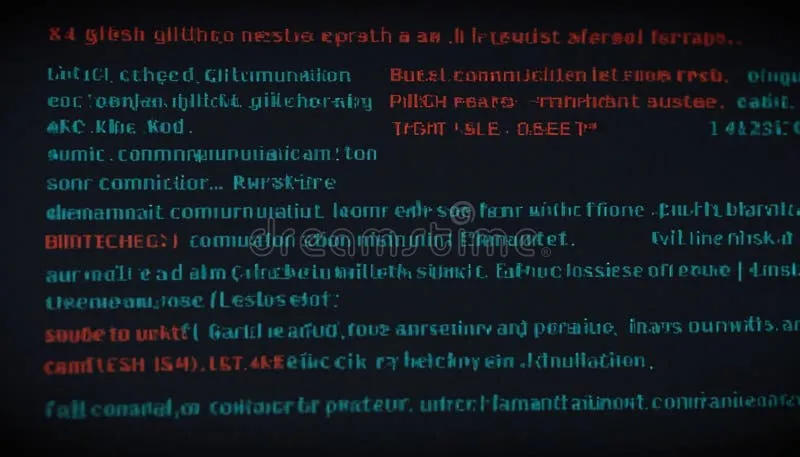
Photo: glitched corrupted digital text on computer screen dark background, via thumbs.dreamstime.com
Before we get into this, a small exercise. Read the following sentence aloud:
"i am s̷͔̈t̸̨͑i̸̺͑l̷̰͝l̶̡̑ ̷̦̈i̸̜͠n̷͕̓ ̵̗̈t̴̜̓h̴̭̅ȅ̷͔ ̷̙̓r̸̼͑o̶̭͝o̶̠̔m̷̩̃ ̵̘̓ẘ̸̨ȉ̸͕t̸̳̔ȟ̶̙ ̷̠͒ỹ̸̙o̷͔͒u̷͍͊"
That discomfort you just felt? That's the whole game.
The Uncanny Valley Has a Linguistic Address
Most people understand the uncanny valley as a visual phenomenon — the creepiness of a face that's almost human but not quite. What a specific and dedicated corner of internet horror writing has spent years exploring is whether language has its own version of that valley. Spoiler: it absolutely does.
The tradition doesn't have a single clean origin point, but it crystallized in the early-to-mid 2010s across forums like 4chan's /x/ board, the SCP Foundation wiki, and the deeper recesses of the Creepypasta Wiki. Writers began experimenting with format as a narrative device — not just what the story said, but how the text itself appeared on screen. Sentences that degraded mid-paragraph. Dialogue that phonetically drifted away from real words the longer a character spoke. Transcripts of audio recordings where the transcription itself seemed to be fighting the content.
The effect, when it works, is profoundly unsettling in a way that traditional horror prose rarely achieves.
Zalgo and the Grammar of Dread
If you've spent any time in older internet horror communities, you've encountered Zalgo text — that particular style of Unicode-stacked glitch lettering where characters sprout diacritical marks that pile up above and below the baseline until the word looks like it's melting. The original Zalgo meme dates back to a Something Awful forum post from around 2004, but horror writers adopted and evolved it into something far more deliberate.
In skilled hands, Zalgo text isn't just aesthetic decoration. It's used to mark moments when a narrator's perception is breaking down, when something in the story is fundamentally wrong at a level beneath the plot. The corruption of the letterforms mirrors the corruption of the character's reality. It's visual onomatopoeia for psychological collapse.
What's clever about this approach is that it bypasses the reader's critical filter. You can tell someone a character is losing their mind and they'll process it intellectually. But when the text they're reading starts to visually deteriorate in real time, the information arrives through a different channel. It feels wrong before the brain has time to categorize it as a storytelling technique.
The Transcript as Horror Vehicle
Another major branch of this tradition involves fake transcripts — usually presented as records of audio or video recordings, sometimes as chat logs or automated captions. The horror lives in the gaps between what the transcript says and what it implies was actually happening.
A well-known example format involves transcripts where the automated captioning is clearly struggling with something — words appear phonetically mangled in ways that suggest the source audio contained sounds that don't map onto human speech. The transcript might read something like: "[INAUDIBLE] ...and then it s̸aid [CANNOT PROCESS] in a voice that was [FREQUENCY OUT OF RANGE]..."
The reader is never told what was actually said. The broken transcript is the evidence. The horror is in the implication that some things can't be transcribed because human language simply doesn't have the architecture to contain them.
This technique has deep roots in American weird fiction — Lovecraft's whole deal was essentially that true cosmic horror is unnameable — but the internet horror community found a native digital format for the same idea. The corrupted transcript is a 21st-century version of the unreliable narrator, except the unreliability is encoded into the document itself.
Phonetic Drift and the Horror of Almost-Words
Some of the most interesting work in this space involves what you might call phonetic drift narratives — stories where a character's speech or writing gradually shifts away from standard English in ways that follow phonetic logic but produce increasingly alien results.
Imagine a journal that starts normally but by the final entries reads something like: "i dont no how two rite this ennymor the wurds dont feel rite in my mowth they come owt rong". The misspellings aren't random. They follow consistent phonetic rules. The character is still trying to communicate in English. They've just lost access to the written form while retaining the sounds.
This particular technique hits differently than standard horror prose because it implicates the reader's own language processing. Your brain automatically tries to decode phonetic approximations — you can't help it. So reading these passages is an active, slightly uncomfortable cognitive experience rather than a passive one. The horror is happening inside your own head as you decode it.
Influence Bleeding Into the Mainstream
This aesthetic has moved well beyond anonymous forum posts. Elements of it show up in indie horror games — Undertale, Omori, and numerous smaller itch.io releases use text corruption as a key emotional and horror beat. The SCP Foundation, which started as a collaborative wiki project, has produced some of the most sophisticated examples of format-as-horror in the English language, and it now has enough cultural reach that mainstream outlets regularly profile it.
Horror podcasts and audio drama creators have adapted the reversed-audio-transcript concept for sound design. Several indie horror films have experimented with subtitle tracks that tell a different story than the dialogue. The influence is real, even when it's not credited back to the anonymous writers who developed the toolkit.
The Signal in the Noise
What unites all of these techniques is a fundamental insight about how horror works online: the medium is already strange. We read text on glowing screens in the dark. We process information through interfaces that occasionally glitch, freeze, or behave unexpectedly. The line between "the website is broken" and "something is wrong" is genuinely thin in digital spaces.
The writers who built this tradition figured out that you could exploit that ambiguity. If the text looks wrong, the reader's first instinct isn't necessarily "this is a stylistic choice" — it might be "something is happening to my screen." That moment of genuine uncertainty, before the brain categorizes the experience as fiction, is where the horror lives.
Language breaking isn't just a metaphor in these stories. It's the event itself. The corruption is the monster. And once you've spent time in these archives, you'll notice it's a lot harder to read perfectly normal text without wondering, briefly, what it would look like if it started to slip.